The Blog

The Latest from the Endangered Species Coalition

A close-up of a bumblebee collecting nectar from pale purple flowers, with a soft-focus green and yellow background.
Press Release

On “Day Zero” for American Wildlife, Groups Across the Country Denounce Trump’s Attack on Endangered Species’ Habitat

The decision to rescind the regulatory definition of “harm” under the Endangered Species Act (ESA) could enable extractive industries to destroy or modify the habitat of imperiled plants and animals — the places they need to feed, shelter, raise their young — even if it results in their death or injury.

A wolf lies quietly in a dimly lit rocky forest setting, offering a glimpse into wildlife serenity.
Endangered Species Act

Bipartisan Former Wildlife Agency Leaders Defend Longstanding Endangered Species Act “Harm” Definition

Seven former leaders of the U.S. Fish and Wildlife Service and NOAA Fisheries have sent a letter to Interior Secretary Douglas Burgum and Commerce Secretary Howard Lutnick urging the administration to withdraw its recent rollback of the Endangered Species Act’s definition of “harm.”

Get alerts and updates

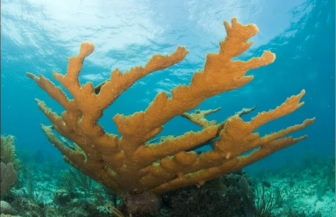
Large elkhorn coral rises from the seafloor in branching, antler-like shapes beneath clear blue water.
Blog

Florida’s Coral Reefs Need More Than Protection. They Need Commitment

Florida’s staghorn and elkhorn corals once helped build the living reefs that protect coastlines, support fisheries, shelter marine life, and define Florida’s ocean heritage. Their functional extinction is a heartbreaking warning about what happens when climate change, pollution, and underfunded conservation collide. But this moment must also be a call to action: with fully funded coral recovery programs, science-based protections, and renewed commitment to the Endangered Species Act, Florida’s reefs can still have a fighting chance.
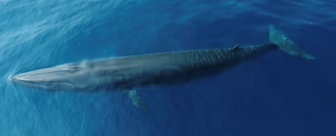
A large baleen whale, likely a fin whale, swims just below the surface of deep blue ocean water. Its streamlined body shows faint white markings near the head and distinct parallel pleats or grooves along its underside extending from the jaw to mid-body. A small dorsal fin and part of its tail flukes are visible, and the water appears slightly agitated around the whale.
Blog

How Many Whales Does It Take To Save A Species? The Story Of The Rice’s Whale

How many whales does it take to save a species? For the Rice’s whale, the answer may be all of them. Found only in the Gulf of Mexico, this newly recognized species is already on the edge of extinction, with just 51 estimated to remain. By studying individual whales, scientists have uncovered critical insights about how Rice’s whales feed, rest, travel, and survive in one of the most industrialized marine environments in the world. Their stories are a reminder that science, not politics, must guide decisions about endangered wildlife, and that every protection matters when extinction is this close.
A long wooden pier extends over calm, blue-green ocean water under a clear sky. A tall wading bird stands in the shallow water near the sandy beach in the foreground. Small waves gently lap the shore.
press

Following Endangered Species Day, Hundreds Rally Across the Country Against “God Squad” Exemption Shielding Oil and Gas from Endangered Species Act 

Coordinated demonstrations across Florida, Louisiana, Texas, Massachusetts, and California oppose sweeping rollback threatening marine life in the Gulf

Two orcas swim near the surface of calm water during a vibrant orange and purple sunset, with the sun low on the horizon and its reflection shimmering across the sea.
press

Statement on Westerman’s ESA Rollback Bill (H.R. 1897) Being Pulled from Floor Consideration

The decision to pull Westerman’s ESA rollback bill (H.R. 1897) from floor consideration is good news for the Endangered Species Act, threatened and endangered wildlife and for the millions of people who care about protecting nature and cherished species.

Defend endangered species

Support our work

The Endangered Species Coalition is a non-profit organization and relies on the support of grassroots donors. Please make a tax-deductible gift today to allow us to continue organizing and mobilizing for endangered species.